Aging and Social Change International Award for Excellence

The Journal of Aging and Social Change offers an annual award for newly published research or thinking that has been recognized to be outstanding by members of the Aging & Social Change Research Network.

Award Winners for Volume 15
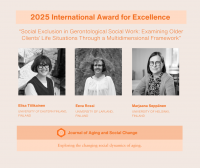
Social Exclusion in Gerontological Social Work: Examining Older Clients’ Life Situations Through a Multidimensional Framework

Social exclusion is one of the key challenges faced by aging societies and a critical driver of the need for gerontological social work. This article examines social exclusion in gerontological social work from the perspective of social workers’ perceptions of older clients’ challenging life situations in Finland. The study utilizes a multidimensional framework of social exclusion, dividing it into five interconnected domains: exclusion from social relations, economic exclusion, exclusion from services, community and spatial exclusion, and civic exclusion. The data consists of seven online focus group interviews with twenty-two social workers and is analyzed using theory-driven content analysis. The results show that all five domains of social exclusion were embedded in the social workers’ perceptions of older clients’ challenging life situations. The domains were interconnected and overlapping, and in some cases, older clients were excluded from multiple domains building into complex needs. The findings provide a new understanding of the diverse disadvantages that older adults often experience and can be utilized when developing practices and interventions of gerontological social work.


Older adults in need of gerontological social work have social and health problems and complex life situations. The focus of gerontological social work has often been on care and health needs instead of responding to diverse social problems related to aging and later life. The multidimensional framework of social exclusion has been found to be useful for acknowledging the diverse disadvantages of older adults. However, it has been rarely used in the context of gerontological social work. Our study contributes to this research gap and demonstrates that the multidimensional framework provides more in-depth understanding of life situations of older adults in need of gerontological social work. In addition, the framework makes visible the connection between societal factors and individual life histories and circumstances of older adults. The findings and implications of this study can be used when developing interventions aimed at reducing social exclusion of older adults living in vulnerable life situations. Furthermore, the findings can be used in social work education across countries. In Finland, we have already integrated the findings in courses and lectures regarding gerontological social work and found that the empirical examples can help especially younger students recognise and understand support needs related to older client's complex life situations.

—Elisa Tiilikainen, Eeva Rossi, and Marjaana Seppänen

Past Award Winners

Volume 14

Keep Working! But Not with Us?: Sweden’s Pension Policy on Retirement Age and Government Agencies’ Recruitment Practices

Lisbeth Segerlund, The International Journal of Aging and Social Change, Volume 14, Issue 1, pp.97-122


Volume 13

Supported Decision-Making in the Japanese Context: Developments and Challenges

Yukio Sakurai, The International Journal of Aging and Social Change, Volume 13, Issue 1, pp.151-169


Volume 12

Arts on Prescription for Older People: The Professional Artist’s Facilitation of Psychological Well-Being

Bruce Walmsley, Roslyn G. Poulos, and Christopher J. Poulos, The International Journal of Aging and Social Change, Volume 12, Issue 1, pp.103-118


Volume 11

Older Adults’ and Carers’ Engagement in Democratic Governance in the Context of System and Government Transition

Laura Funk, Andrea Rounce, and Danielle Cherpako, The International Journal of Aging and Social Change, Volume 11, Issue 1, pp.81-97


Volume 10

Livable and Age-Friendly Communities: A Scoping Review of Conceptual Frameworks

Jill Chonody, and Barbra Teater, The International Journal of Aging and Social Change, Volume 10, Issue 1, pp.35-53


Volume 9

The Role of Participatory Arts in Developing Reciprocal Relationships amongst Older People: A Conceptual Review of the Literature

Ceri Wilson, Anna Dadswell, Carol Munn-Giddings, and Hilary Bungay, The International Journal of Aging and Social Change, Volume 9, Issue 4, pp.1–16


Volume 8

Seeing Healthcare through a Social Work Lens: Tackling Disparities and Inequalities for the Elder African American Male

Cristina Joy Torgé, The International Journal of Aging and Social Change, Volume 8, Issue 1, pp.45–60


Volume 7

Seeing Healthcare through a Social Work Lens: Tackling Disparities and Inequalities for the Elder African American Male

Patrick Burden, The International Journal of Aging and Society, Volume 7, Issue 4, pp.73–82


Volume 6

From Aging in Community to Age-friendly Community: Translating Applied Research into Practice

Kathy Black and Kathyrn Hyer, The International Journal of Aging and Society, Volume 6, Issue 4, pp.59-71


Volume 5

Let’s Talk about Dying: Proposals for Encouraging Discussion of Advance-care Planning

Rosemary Venne, Donna Goodridge, Elizabeth Quinlan, and Paulette Hunter, The International Journal of Aging and Society, Volume 5, Issue 4, pp.33–46


Volume 4

The Role of Food in Supporting Healthy Aging: A Stakeholder Perspective

Orla Collins and Joe Bogue, The International Journal of Aging and Society, Volume 4, Issue 3-4, pp.1–12


Volume 3

Exploring Older People’s Perspectives of Community Organizing: A Photovoice Study in the Philippines

Crystal Kwan and Christine A. Walsh, The International Journal of Aging and Society, Volume 3, Issue 1, pp.15–30


Volume 2

The Role and Contribution of Philanthropy to the Lives of Older People in Ireland

Andy Cochrane, Sinéad McGilloway, Mairéad Furlong, and Michael Donnelly, The International Journal of Aging and Society, Volume 2, Issue 2, 13–23