Award Winner for Volume 15
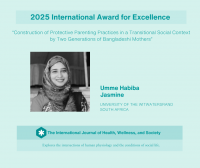
Construction of Protective Parenting Practices in a Transitional Social Context by Two Generations of Bangladeshi Mothers
The construct of protective parenting in Bangladesh is understudied. To address this gap, this study explored how two generations of Bangladeshi mothers constructed protective parenting practices. This study followed a cross-sectional hermeneutic phenomenological research design. Using purposive sampling, eleven maternal grandmothers (first generation, G1) and eleven mothers (second generation, G2) were selected. Data were collected using semi-structured in-depth interviews and analyzed using the hermeneutic circle. Eight protective parenting practices were uncovered: monitoring and choosing friends for children, gender boundaries, chaperonage, arranging marriage, religious upbringing, engineering fear, observing traditional rituals, and saving money. While protective parenting values were sustained across both generations, differences were revealed between the G1 and G2’s identification of security risks and modes of ensuring safety. The findings of this study emphasize the importance of considering cultural and social contexts in understanding parenting. The scholarly contributions of this article are the identification, contextualization, and definition of protective parenting practices. Additionally, this study contributes to research methodology discourses by presenting a parenting dimensions framework to study parenting practices in under-researched communities. In future studies, fathers, grandfathers, and paternal grandmothers should be included to glean a more complete picture of the protective practices of Bangladeshi parents. This study highlights the need to develop effective social safety policies with the efforts of administration, community organizations, and residents’ representatives. This study also offers insights into rendering parenting interventions more culturally appropriate.
Parenting practices in Bangladesh remain significantly underexplored within the broader literature on child development and family studies. This article addresses this gap by examining the intergenerational construction of protective parenting practices within a culturally specific Bangladeshi context. By situating parenting within the intersecting influences of cultural norms, social learning, familial modelling, and guidance from elders in often unsafe community environments, the study provides a nuanced and contextually grounded understanding of how caregiving strategies are developed and sustained.
A key contribution of this research lies in its in-depth exploration and conceptualization of protective parenting practices as they are locally understood and enacted. In doing so, the study foregrounds a population and cultural context that has historically received limited scholarly attention. Importantly, the findings reveal a complex and, at times, contradictory dynamic within these practices. While protective parenting is primarily oriented toward safeguarding children, certain strategies—such as early marriage for girls—reflect a perceived need for social protection, even when such practices may undermine other dimensions of children’s wellbeing. This tension highlights a critical area for further inquiry, particularly in relation to how structural insecurity and sociocultural expectations shape parental decision-making, and turn protection into endanger practices.
Beyond its empirical contributions, the article advances methodological discourse by proposing a parenting dimensions framework tailored to under-researched communities. This framework facilitates a more culturally responsive approach to studying parenting, enabling researchers to capture both the diversity and specificity of caregiving practices across contexts.
In terms of its intellectual significance, this work contributes to expanding the global scope of parenting research by integrating perspectives from the Global South, thereby challenging dominant, often Western-centric models of parenting. It also informs future research, policy, and intervention design by emphasizing the importance of culturally embedded understandings of care, protection, and risk. Collectively, the study not only fills a critical gap in the literature but also lays the groundwork for more inclusive and context-sensitive scholarship in the field.
—Umme Habiba Jasmine