Award Winner for Volume 25
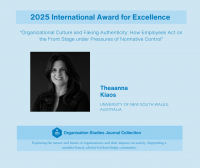
Organizational Culture and Faking Authenticity: How Employees Act on the Front Stage under Pressures of Normative Control
This study contributes rare findings concerning the changing nature of employee language and behavior on the front stage. Little empirical research presents front-stage displays when employees across various membership groups consistently enact alignment to an organization’s managerial ideology and prescriptive culture. Guided by an interpretative framework, this study examined the integrationist perspective of culture. Seventy-four qualitative interviews were conducted in combination with ethnographic methods within a public sector agency based in New South Wales (Australia). Thematic analysis revealed front-stage displays reflecting employees’ alignment to the Service NSW customer-centric ideology promulgated by its “DNA” culture, showing that some employees were surface acting whereas others were deep acting. On the front stage, employees across the organization’s hierarchy reflected consistent presentations of the self despite being part of different departments. Employees displayed front-stage engaged, empowered, and authentic selves while, at times, it was shown that they were suppressing their true felt emotions and cognitions. By presenting a framework to identify language and behavioral changes on the front stage under the constraints of ideology and culture, researchers are provided with opportunities to observe, document, and interpret the self-conscious monitoring of their participants’ language and behavior, whereby a deeper exploration of employees’ subjective experiences is within reach.
My intellectual preoccupation has long been the space between what organisations say they are and what employees actually experience. This article is where that preoccupation became empirical.
Most organisational culture research describes what culture is. This study examines what it does — specifically, what it does to the people working inside it. Drawing on ten months of ethnographic fieldwork and 74 qualitative interviews conducted at Service NSW, it documents how a carefully crafted customer-centric ideology — the agency’s “DNA” culture — functioned as a system of normative control, shaping not just what employees did but how they presented, thought, and felt about themselves at work.
Service NSW gave me an unusually clean case. The organisation’s culture was explicit, pervasive, and actively managed by agents of authority who understood exactly what they were doing. What I did not anticipate was how elegant the concealment would be. Employees were encouraged to play, to be genuine, to bring their whole selves — and the data show that this invitation was also a mechanism of cultural control. When organisations ask employees to be themselves while simultaneously prescribing what that self should look like, they create a double bind that is psychologically costly precisely because it is ideologically invisible. Normative control at its most effective is not felt as pressure. It is felt as freedom.
A finding I consider particularly significant concerns frontline centre employees. These workers were the least senior, the least paid, and the most culturally and linguistically diverse cohort in the study. They were also the most exposed to chronic emotional suppression — performing emotional labour directly with customers while managing simultaneous scrutiny from above. The long-term psychopathological implications of this exposure — burnout, disengagement, identity diffusion — deserve far more research attention than they currently receive.
This article is one point in a longer intellectual arc. It builds on a conceptual framework I developed in 2023 to integrate managerial ideology, normative control, and presentations of the self — constructs that had largely evolved in isolation from one another. The framework paper was a provocation; this study was its empirical test. My subsequent research on customer-centric ideology and burnout symptoms in the NSW public sector, published in the Journal of Workplace Behavioral Health in 2026, pursued the psychopathological downstream of what this article documents at the behavioural level. The book I am currently completing, The Dancefloor, takes its title from the term Service NSW employees used for the customer-facing floor space — the site where performance demands are most acute and least examined.
For scholars and practitioners alike, the central implication is this: culture audits that measure only visible behaviour miss the most consequential layer of workplace experience. The lived gap between espoused values and daily reality is precisely where psychological risk accumulates — and where the boundary between cultural pressure and psychological harm remains dangerously unexamined.
—Theaanna Kiaos