Call for Papers
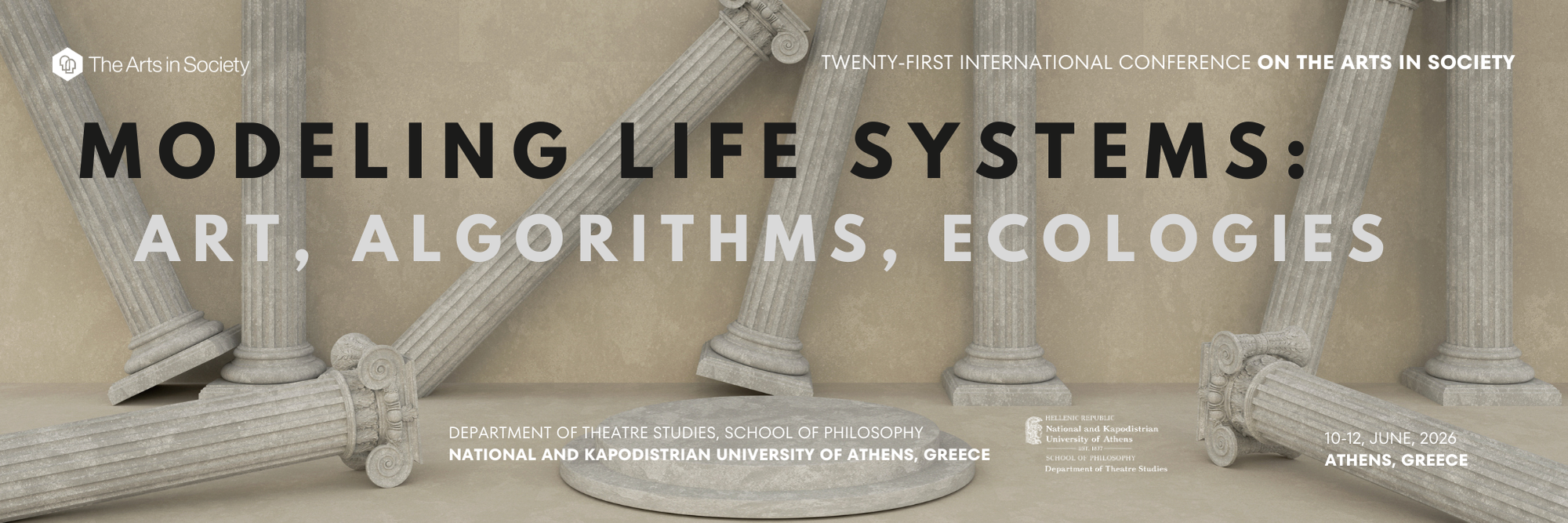
We invite you to join us for the Twenty-First International Conference on the Arts in Society, to be held 10–12 June 2026 at the Department of Theatre Studies, School of Philosophy, National and Kapodistrian University of Athens, Greece, with full online participation through CGScholar Event (KX). Since its founding, the Arts in Society Research Network has brought together artists, scholars, educators, curators, and community practitioners who are interested in how the arts work in the world—on stage and on screen, in classrooms and galleries, in streets and communities, and across networks and media. In this spirit, we invite proposals that link artistic and scholarly work to the intellectual and practical questions that shape our present.
Special Focus and Themes
For 2026, we invite contributions that speak to the special focus “Modeling Life Systems: Art, Algorithms, Ecologies.” We are interested in work that helps us see and understand the entanglements of living systems, technological infrastructures, and planetary ecologies—whether through critical analysis, creative practice, or collaborative projects. You might address, for example, how artists respond to climate and environmental change, how algorithmic systems shape aesthetic experience, or how communities use creative practice to reimagine shared futures. A fuller description of the Special Focus is available on the conference website, and we encourage you to consult it as you frame your proposal. Alongside this focus, we continue to welcome work across the Network’s ongoing themes, including pedagogies of the arts; arts histories and theories; new media, technology, and the arts; and the arts in social, political, and community life.
Knowledge Experience and Format
We invite you to participate in a conference designed as a hybrid knowledge experience, not a one-off event. All accepted proposals become Presentation Pages in CGScholar Event (KX), where you can share abstracts, media, and questions and remain in conversation before, during, and after the meeting. In-person sessions at the National and Kapodistrian University of Athens sit alongside live online sessions and asynchronous presentations within a single integrated schedule, so whether you travel to Athens or join online, you enter the same scholarly environment. You may participate as a presenter or as an audience member, in person or online, and in every mode our aim is to sustain reciprocal, human-scale exchange rather than one-way spectacle.
Publication Pathways
We also invite you to consider the conference as a step in a longer publication journey. After the event, presenters are encouraged to develop their work for possible publication in the Arts in Society Journal Collection or in books associated with the Research Network. All submissions are reviewed according to established scholarly standards. While presentation does not guarantee publication, it provides a supported pathway from initial idea to peer-reviewed article or chapter.
Membership and Community
By presenting at the conference, you also join the Arts in Society Research Network as a member, as membership is included in all Presenter Passes. We invite you to see this not simply as access to journals and books, but as participation in a community organised by and for its members—sustained through conferences, publications, and the shared infrastructures of CGScholar (KX). Your proposal is thus an entry point into an ongoing cycle of dialogue, collaboration, and collective work.
Sincerely,
Daniel Tucker, Research Network Chair, Independent Scholar, United States of America
Dr. Pilar Irala-Hortal, Research Network Chair, Universidad San Jorge, Zaragoza, Spain
Dr. Clio Fanouraki, Conference Chair, National and Kapodistrian University of Athens, Greece
Dr. Phillip Kalantzis-Cope, Chief Social Scientist, Common Ground Research Networks, United States of America