Call for Papers
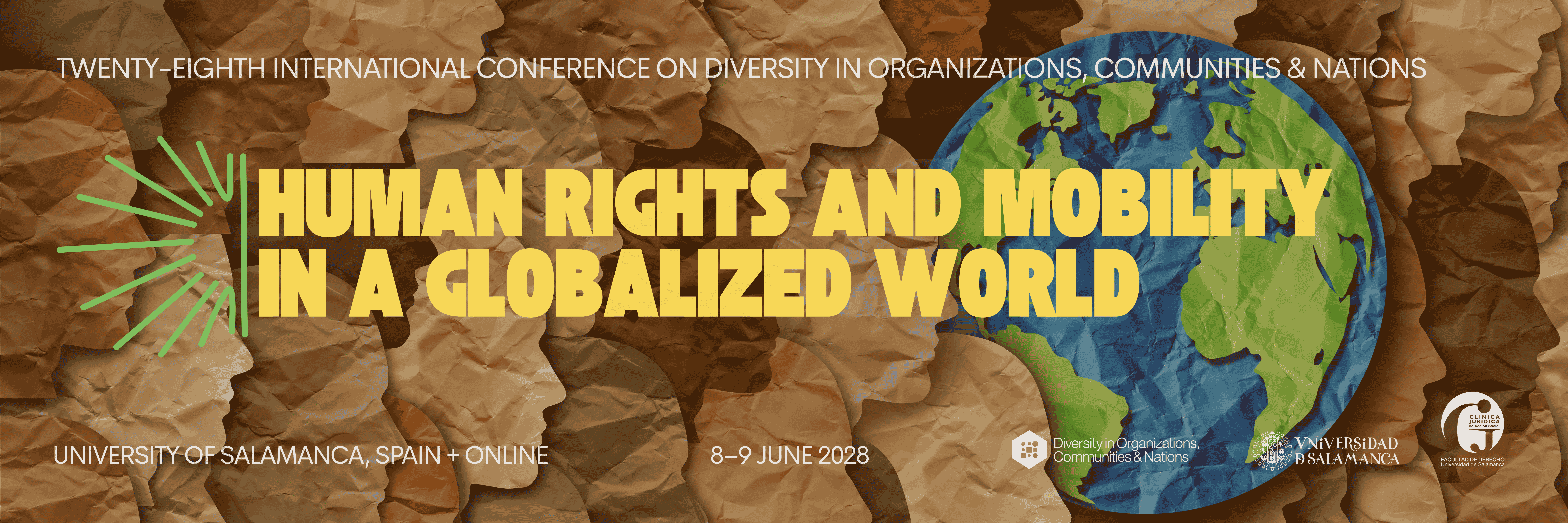
We invite you to join us for the Twenty-Eighth International Conference on Diversity in Organizations, Communities & Nations, the annual meeting of the Diversity in Organizations, Communities & Nations Research Network, hosted by the University of Salamanca, taking place in Salamanca, Spain, and online, 8–9 June 2028.
Founded in 2000, the Diversity in Organizations, Communities & Nations Research Network is brought together by a shared interest in human differences and diversity, and their varied manifestations in organizations, communities, and nations. The Network traverses a broad terrain—sometimes technical and sometimes socially oriented, sometimes theoretical and sometimes practical—while building an epistemic community across disciplinary, geographic, and cultural boundaries.
The Network brings researchers, practitioners, educators, and policymakers into conversation about the conditions of participation, belonging, equity, and institutional legitimacy in plural societies. Proposals and presentations are welcomed in English and Spanish.
Human Rights and Mobility in a Globalized World
Human mobility is a defining condition of contemporary life. People move across borders for work, education, safety, family, aspiration, and survival, while others are prevented from moving, displaced without protection, or rendered socially and legally immobile. Global mobility is therefore not distributed equally: it is shaped by citizenship, race, gender, class, disability, nationality, legal status, borders, labor markets, and institutional power.
The 2028 special focus asks how human rights frameworks respond to these unequal conditions of movement and belonging. It invites inquiry into migration, asylum, citizenship, displacement, diaspora, labor mobility, transnational identities, and the rights of people whose lives cross or are constrained by national boundaries.
Proposals may examine how organizations, communities, nations, and transnational institutions create, protect, deny, or renegotiate rights in a mobile and interdependent world. We welcome theoretical, empirical, legal, policy-oriented, professional, educational, artistic, and community-based contributions.
Themes
- Power, Policy, and Democratic Governance: rights, representation, accountability, and the politics of inclusion in plural societies.
- Migration, Mobility, and Belonging: citizenship, borders, diasporas, identity formation, and everyday experiences of belonging/exclusion.
- Organizations, Work, and Economic Inequality: employment, labor markets, professional cultures, discrimination, and equity in organizational life.
- Education, Media, and Digital Pluralism — schooling, public discourse, platform dynamics, misinformation, and the shaping of diversity in digital societies.
Alongside the special focus, the conference welcomes proposals across the full scope and concerns of the Research Network, including identity, equity, power, participation, community governance, cultural difference, and the changing conditions of diversity across local and global contexts. The special focus is an invitation, not a limitation: proposals engaging the Network’s core themes are warmly encouraged.
Knowledge Experience and Format
The conference is organised as a hybrid knowledge experience, integrating in-person and online participation within a unified scholarly environment.
For in-person delegates in Salamanca, the conference is designed as a human-scale gathering shaped by conversation, shared inquiry, and place-based exchange. Sessions, breaks, and informal encounters create opportunities to connect research with legal practice, education, public life, community knowledge, and the real-world contexts in which rights and mobility are negotiated.
For online delegates, the conference is more than a remote viewing option. Accepted proposals become Presentation Pages in CGScholar where presenters share abstracts, media, and supporting materials. Delegates participate through live online sessions, asynchronous engagement, and discussion spaces that remain available before, during, and after the event.
Across both formats, the emphasis is on reciprocal exchange rather than one-way presentation. Whether joining in Salamanca or online, participants are part of a shared knowledge environment where ideas can be presented, discussed, revisited, and developed into future collaborations, publications, educational practices, and community initiatives.
Publication Pathways
Accepted presenters are invited to further develop their conference work for possible publication through the Diversity in Organizations, Communities & Nations Journal Collection. The Collection currently includes The International Journal of Organizational Diversity, The International Journal of Community Diversity, The International Journal of Diverse Identities, and The International Journal of Diversity in Education. These peer-reviewed bilingual journals provide pathways for research on identity, equity, power, participation, migration, labor, education, social movements, organizational life, community governance, and policy.
Presenters may also propose extended works for the Diversity in Organizations, Communities & Nations Book Imprint, which publishes monographs and edited collections advancing research and practice on the forms and futures of human difference.
All accepted proposals are included in the conference proceedings, providing a formal record of the conference program and presentation abstracts. Proceedings help make presenters’ work discoverable as part of the annual knowledge record of the Research Network.
Member-Based Research Community
Membership in the Diversity in Organizations, Communities & Nations Research Network is the gateway to year-round community and access, connecting members with journals, books, programs, archives, and ongoing scholarly exchange. A Presenter Pass includes membership; visit the CGScholar member community or learn more about becoming a member.
Join Us
We warmly invite you to submit a proposal and to join us—either in Salamanca or online—for the Twenty-Eighth International Conference on Diversity in Organizations, Communities & Nations. Together, we will examine how human rights, mobility, and belonging are shaped across organizations, communities, nations, and transnational worlds.
Sincerely,
Dr. Eugenia Arvanitis, Research Network Chair, University of Patras, Greece
Dr. Carmen Miguel Vicente, Research Network Chair, Compultense University of Madrid, Spain (ES)
Dr. Mari Ángeles Medina Sánchez, Research Network Chair, Compultense University of Madrid, Spain (ES)
Dr. Phillip Kalantzis-Cope, Chief Social Scientist, Common Ground Research Networks, United States of America