Call for Papers
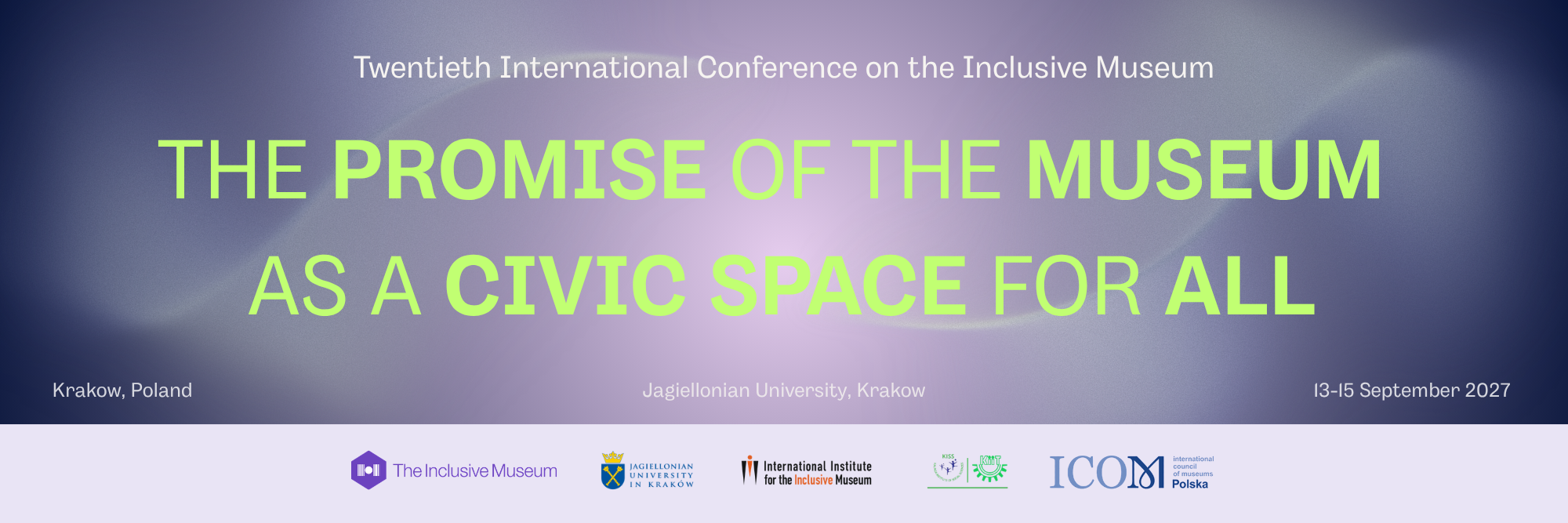
We invite you to join us for the Twentieth International Conference on The Inclusive Museum, the annual meeting of The Inclusive Museum Research Network, to be held at Jagiellonian University, Krakow, Poland, 13-15 September 2027, with online participation also available.
The 2027 conference explores the special focus, “The Promise of the Museum as a Civic Space for All.” At a time of social fragmentation, democratic strain, cultural contestation, and institutional transformation, museums are being asked to do more than preserve and interpret collections. They are increasingly called upon to act as civic institutions: places where communities gather, difficult histories are confronted, public cultures are shaped, and more inclusive futures are imagined.
The conference invites participants to consider what it means for the museum to serve as a civic space for all. What forms of inclusion are possible, and under what conditions? How can museums create meaningful access across differences of class, race, ethnicity, language, age, disability, migration status, and cultural belonging? How might they balance stewardship and authority with participation, plurality, and public accountability? And how do museums respond when civic space itself is under pressure?
Hosted in Krakow, a city marked by layered histories, cultural memory, and contemporary public debate, the conference offers an especially resonant setting for examining the museum’s civic role. We welcome proposals from scholars, curators, educators, artists, designers, archivists, policy makers, and museum professionals who are rethinking the museum as a space of encounter, dialogue, justice, and shared cultural life.
Special Focus and Themes
The special focus, “The Promise of the Museum as a Civic Space for All,” encourages contributions that engage questions such as these: How can museums foster belonging without flattening difference? What does civic participation look like in museum practice? How do museums navigate contested narratives, colonial inheritances, restitution debates, and the politics of representation? What role can museums play in supporting democratic culture, community voice, and public trust?
We welcome contributions that explore these and related issues through research, professional practice, exhibition-making, education, public programming, digital engagement, curatorial experimentation, and institutional critique.
Sub-themes
- Museums, Democracy, and Civic Life: Exploring the museum as a public institution that can foster dialogue, participation, trust, and cultural citizenship in times of social and political change.
- Inclusion, Access, and Belonging: Considering how museums create meaningful access and participation across differences of language, culture, class, age, disability, migration status, and identity.
- Memory, Representation, and Justice: Examining how museums engage difficult histories, contested narratives, restitution, colonial legacies, and the politics of visibility and voice.
- Education, Community, and Institutional Futures: Focusing on museum learning, public engagement, co-creation, digital participation, and new institutional models for more inclusive practice.
Alongside the special focus, proposals may also address the broader themes of The Inclusive Museum Research Network, including the museum’s role in society, practices of inclusion and exclusion, curatorial and educational innovation, and the changing relationships among collections, communities, and publics.
Format
This conference will be held in a blended format, with opportunities for both in-person and online participation. The conference environment is designed to support exchange before, during, and after the event, bringing together presenters and delegates across locations in one integrated scholarly space.
All accepted presenters will have access to a Presentation Page, where they can share abstracts, presentation materials, and supporting media, and where conference participants can engage in discussion. This format supports a fuller cycle of scholarly communication, extending beyond the live session to include preparation, dialogue, reflection, and future development.
Publication Pathways
Presenters are invited to develop their conference contributions for possible publication in The International Journal of the Inclusive Museum. This peer-reviewed journal publishes research addressing the roles, responsibilities, and futures of museums in relation to inclusion, participation, representation, and public culture.
Participants may also propose extended works for the Inclusive Museum Book Imprint, which publishes scholarly and practice-based books exploring the museum’s evolving place in society.
Who Should Participate
This conference will be of interest to museum professionals, curators, educators, archivists, historians, artists, designers, cultural policy researchers, heritage practitioners, and scholars across the humanities and social sciences. We especially welcome interdisciplinary and international perspectives, as well as proposals that bridge theory and practice.
Join Us
In a moment when the meaning of public institutions is being tested and reimagined, the museum remains a vital site for reflection, encounter, and collective life. The Twentieth International Conference on The Inclusive Museum offers a space to consider how museums might more fully realize their promise as civic spaces for all.
We welcome your proposal and your participation in Krakow, Poland, and online.
Sincerely,
Dr. hab. Kinga Anna Gajda, Conference Chair, Jagiellonian University, Kraków, Poland
Dr. Amareswar Galla, Research Network Chair, Inclusive Museum Research Network, India
Dr. Phillip Kalantzis-Cope, Chief Social Scientist, Common Ground Research Networks, United States of America