Award Winner for Volume 15
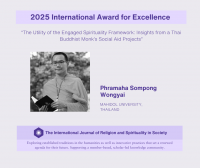
The Utility of the Engaged Spirituality Framework: Insights from a Thai Buddhist Monk’s Social Aid Projects
Engaged Buddhism, with its ethico-rational emphasis, does not always fully explain the complexity of Buddhist social engagement. The case of Buddhist monk Phra Phaisanprachathorn (Phobchok Tissawangso) from northern Thailand illustrates the utility of the engaged spirituality framework in understanding seemingly idiosyncratic cases that deviate from this emphasis. Phra Phaisanprachathorn has initiated extensive social aid projects, including a shelter for the homeless, a food kitchen, and a hospital, driven by his spiritual motivation. This qualitative study analyzed the sources of his spirituality and the means to sustain them using the engaged spirituality framework developed by Stanczak. Through in-depth interviews and immersive observation, the study revealed that Phra Phaisanprachathorn’s spirituality is rooted in a transcendent experience of connection with the Guanyin Bodhisattva and his moral virtue of compassion. These sources are maintained through spontaneous connection, daily practices, and eclectic improvisation. The findings confirm the value of the engaged spirituality framework in understanding other such cases and highlight the importance of transcendent spiritual experiences in Buddhist social engagement. Furthermore, a new category is introduced into the framework and thereby extends its scope.
This article re-examines the conventional framework of engaged Buddhism by drawing on Stanczak’s concept of engaged spirituality, offering a more nuanced understanding of inner motivation. In this context, the connection with the Guanyin Bodhisattva, as identified in this study, serves as a particularly illuminating example. Such experiences have often been overlooked or dismissed as transcendental phenomena or personal narratives lacking academic rigor. However, this study suggests that they can be more productively understood as meaningful spiritual experiences that shape and sustain social engagement.
From this perspective, the article argues that the connection with the Guanyin Bodhisattva—frequently marginalized in academic discourse due to its non-rational character—can function as a significant catalyst for concrete social initiatives, including the establishment of hospitals and shelters. In this sense, spiritual experience can be understood as a form of social capital that contributes to tangible benefits for underserved communities. Furthermore, the introduction of the category of “moral virtue” extends Stanczak’s framework by foregrounding compassion as a central analytical component. This addition helps to clarify the relationship between internal practice and external action, suggesting that spirituality and social engagement are more deeply interconnected than is often assumed.
Taken together, this study goes beyond documenting a monk’s social work. In doing so, it also reflects my broader intellectual trajectory, which seeks to engage with dimensions of human experience that cannot be fully explained through empirical rationality alone. It proposes a way of understanding spirituality as an important resource for sustainable forms of social transformation. Greater recognition of these lived and transcendent dimensions may, therefore, contribute to a more comprehensive and theoretically nuanced approach to the study of religion and socially engaged spirituality in the future.
—Phramaha Sompong Wongyai