Call for Papers
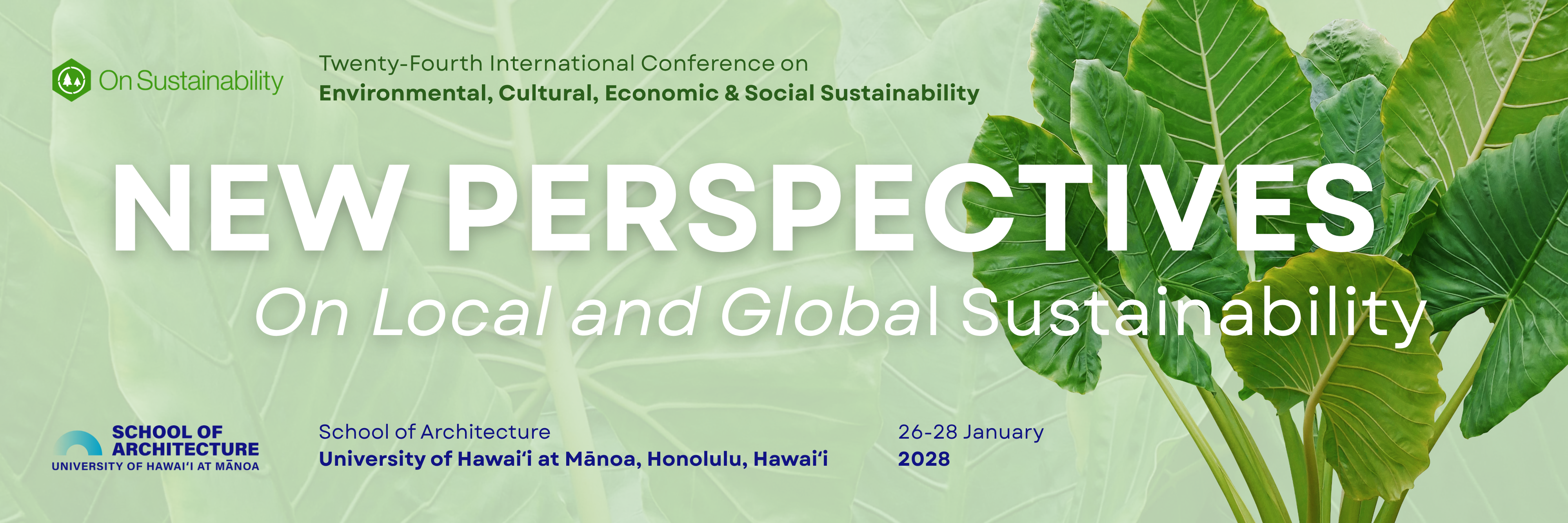
Call for Papers
We invite you to join us for the Twenty-Fourth International Conference on Environmental, Cultural, Economic & Social Sustainability, the annual meeting of the On Sustainability Research Network hosted by the School of Architecture, University of Hawaiʻi at Mānoa, taking place in Honolulu, Hawaiʻi and online. The conference is convened together with the Twentieth Climate Change: Impacts & Responses Conference, creating a shared setting for exchange across sustainability, climate change, architecture, design, policy, culture, and community practice.
The On Sustainability Research Network is a leading forum for researchers, educators, practitioners, policymakers, designers, community leaders, and advocates working across the environmental, cultural, economic, and social dimensions of sustainability. The conference welcomes proposals that examine sustainability not as a single issue, but as a shared challenge linking ecosystems, communities, economies, built environments, cultural practices, institutions, and everyday life.
Today, sustainability questions are urgent at both local and global scales. Key issues include climate adaptation, biodiversity, Indigenous knowledge, environmental justice, sustainable cities, architecture and design, food and water systems, community resilience, cultural heritage, public policy, economic transition, and the responsibilities of institutions, governments, and civil society. We welcome interdisciplinary proposals that engage these questions through research, practice, policy, design, education, activism, and community-based knowledge.
Special Focus
The 2028 special focus, New Perspectives on Local and Global Sustainability, invites participants to examine how sustainability is understood, practiced, and contested across different places, communities, systems, and scales.
Sustainability is never only global, and never only local. It is shaped by planetary systems, climate pressures, land and water use, migration, infrastructure, economic systems, cultural values, and the lived realities of communities. Local practices often reveal the most immediate consequences of global change, while global sustainability goals depend on the knowledge, participation, and creativity of people working in specific places.
This special focus asks how sustainability research and practice can better connect large-scale environmental challenges with local histories, ecologies, cultures, and needs. How can communities respond to climate change while protecting place, identity, and livelihood? How can architecture, planning, policy, and design support more resilient futures? How can Indigenous, local, scientific, and professional knowledge systems work together? What new perspectives are needed to move sustainability beyond abstraction and into meaningful change?
We welcome proposals that address sustainability as a social, cultural, environmental, economic, and spatial challenge, shaped by relationships between people, places, institutions, ecosystems, and futures.
Themes
- Theme 1: Environmental Change, Resilience, and Adaptation: exploring climate pressures, biodiversity, ecosystems, land and water systems, disaster risk, environmental restoration, and community resilience in response to changing environmental conditions.
- Theme 2: Sustainable Cities, Architecture, and Built Environments: examining architecture, urban planning, housing, infrastructure, public space, landscape, design, transportation, and the role of built environments in shaping sustainable futures.
- Theme 3: Culture, Community, and Environmental Justice: considering Indigenous knowledge, cultural heritage, local practice, environmental justice, social equity, community action, education, and the ways sustainability is lived and contested in everyday life.
- Theme 4: Policy, Economy, and Sustainable Transitions: addressing governance, public policy, institutional responsibility, circular economies, sustainable development, food and water systems, energy transition, and the economic changes required for more sustainable societies.
Knowledge Experience and Format
The conference is organized as a hybrid knowledge experience, integrating in-person and online participation within a unified scholarly environment.
For in-person delegates in Honolulu, the conference is designed as a human-scale gathering shaped by conversation, shared inquiry, and place-based exchange. Hosted by the School of Architecture at the University of Hawaiʻi at Mānoa, the conference offers a setting where questions of sustainability, place, design, ecology, culture, and community can be explored in direct relation to island environments and Pacific contexts.
For online delegates, the conference is more than a remote viewing option. Accepted proposals become Presentation Pages where presenters share abstracts, media, and supporting materials. Delegates participate through live online sessions, asynchronous engagement, and discussion spaces that remain available before, during, and after the event.
Across both formats, the emphasis is on reciprocal exchange rather than one-way presentation. Whether joining in Honolulu or online, participants are part of a shared knowledge environment where ideas can be presented, discussed, revisited, and developed into future collaborations, publications, policy conversations, and community initiatives.
Publication Pathways
Presenters are invited to further develop their conference work for possible publication in the peer-reviewed journals of the On Sustainability Research Network:
- The International Journal of Environmental Sustainability
- The International Journal of Social Sustainability in Economic, Social, and Cultural Context
- The International Journal of Sustainability Policy and Practice
Participants may also propose longer-form projects for the Network’s book publishing pathways, including monographs and edited collections that advance research on sustainability, climate, culture, community, policy, design, and social change.
Join Us
We warmly invite you to submit a proposal and join us, either in Honolulu or online, for the Twenty-Fourth International Conference on Environmental, Cultural, Economic & Social Sustainability.
Together, we will examine new perspectives on local and global sustainability, and how research, design, policy, culture, and community practice can contribute to more resilient and equitable futures.
Sincerely,
Dr. Eric Peterson, Conference Chair, School of Architecture, University of Hawai'i at Mānoa, Honolulu, Hawai'i, USA
Dr. Victoria Hurth, Research Network Chair, University of Cambridge, UK
Dr. Phillip Kalantzis-Cope, Chief Social Scientist, Common Ground Research Networks, USA