Award Winners for Volume 21
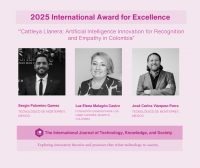
Cattleya Llanera: Artificial Intelligence Innovation for Recognition and Empathy in Colombia
The use of artificial intelligence in peacebuilding and the construction of collective memory represents an emerging opportunity to promote recognition and reconciliation in post-conflict societies without revictimization. This article presents the conceptual and methodological development of Cattleya Llanera, a GPT-based language model designed to facilitate empathetic and context-sensitive dialogue about peace in Colombia. Grounded in the GPT Personalization Methodology based on Life Stories and Dialogue, the model prioritizes the generation of meaningful narratives over information delivery, with the aim of fostering reflection and empathy. The article provides a theoretical framework and a structured methodology for building this AI model, distinguishing it from traditional applications by integrating life testimonies as the core of its identity. While a pilot implementation was carried out after the manuscript was completed, the results are being analyzed and will be presented in a separate study. The technical configuration and development process are documented in a complementary manual that details the model’s internal architecture. This work highlights the relevance of combining technology and human experience to address the challenges of transitional justice and peace education. It sets a precedent for the responsible use of generative AI in conflict mediation, historical memory, and social transformation, while acknowledging the ethical, technical, and methodological limitations that future research must address.
This article emerged as an academic outcome of the project Resignifying the Territory: Female Reintegration and Reincorporation into Peaceful and Sustainable Communities within the Framework of the Peace Process in Colombia, funded by the Ministry of Science, Technology and Innovation of Colombia through the Orquídeas: Women in Science 2024 Program. From this origin, Cattleya Llanera should not be understood only as an artificial intelligence application, but as part of a broader initiative aimed at recognizing, accompanying and making visible the trajectories of women undergoing processes of reintegration and reincorporation, as well as their role in building peaceful and sustainable communities.
The article’s main contribution to the field is to show that generative artificial intelligence can be designed from a logic different from informational automation. The article proposes a situated, narrative and ethically oriented AI, built from life stories, meaningful learning experiences and trajectories of reconciliation. In this sense, it offers a methodology for thinking about conversational models capable of promoting recognition, empathy and dialogue, especially in contexts where technology must operate with sensitivity toward pain, memory and human dignity.
For our academic trajectory, this work represents a natural continuation of our research lines on educational innovation, human competencies, social entrepreneurship and emerging technologies. It also reaffirms a central conviction in our work: innovation only achieves its fullest meaning when it contributes to dignifying lives, strengthening communities and expanding possibilities for social transformation. In Cattleya Llanera, artificial intelligence does not appear as an end in itself, but as a mediation for recognizing trajectories of resilience, supporting reincorporation processes and opening conversations on peace, territory and shared futures.
Therefore, the impact of this article lies in building a bridge between technological development and social responsibility. More than presenting a digital tool, it proposes a way of understanding AI as pedagogical, narrative and ethical accompaniment for processes of memory, reconciliation and nation-building.
—Sergio Palomino Gamez, Luz Elena Malagón Castro, José Carlos Vázquez-Parra