Call for Papers
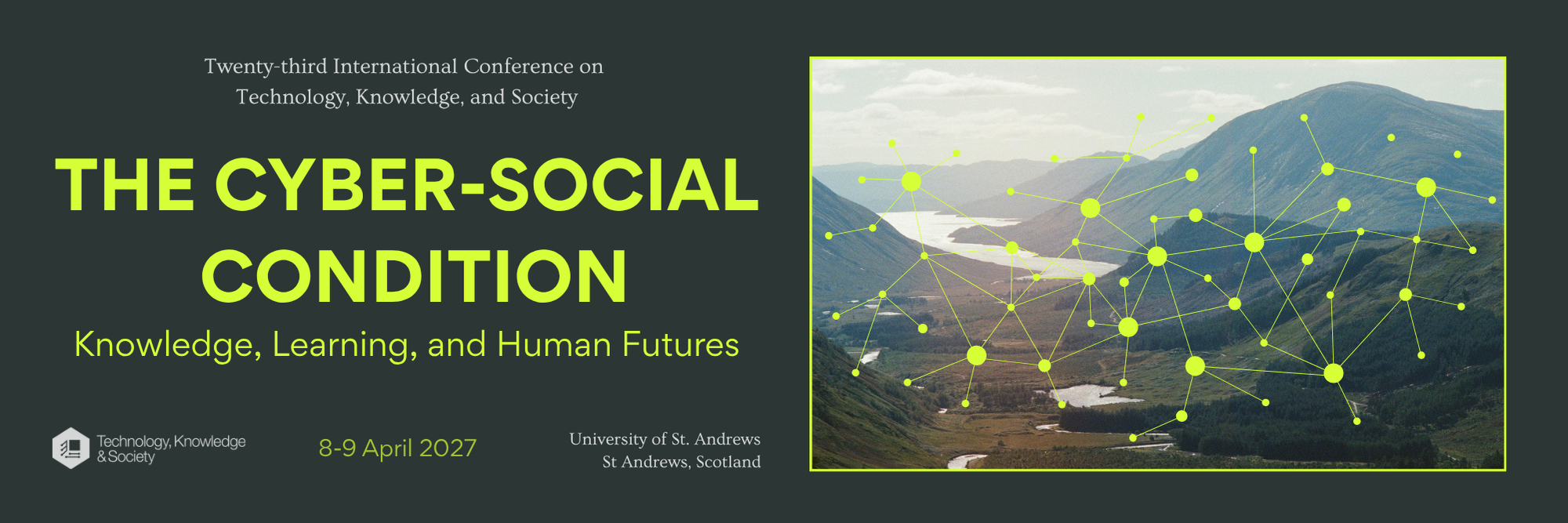
The Cyber-Social Condition: Knowledge, Learning, and Human Futures
The Technology, Knowledge & Society Research Network invites proposals for the Twenty-Third International Conference on Technology, Knowledge & Society, held in conjunction with the Twentieth International Conference on e-Learning & Innovative Pedagogies, to be hosted 8–9 April 2027 by the University of St Andrews in St Andrews, Scotland, with integrated online participation via CGScholar Event (KX).
This combined conference brings together two closely connected scholarly communities in a shared in-person space, creating opportunities for dialogue across research on technology, knowledge, learning, and human futures while preserving the distinct intellectual traditions and conversations of each Research Network. Delegates participate together in plenary sessions and shared events, while contributing to focused discussions within their respective conference programs.
Shared Special Focus and Distinct Conversations
The combined conference is organized around a shared 2027 special focus, “The Cyber-Social Condition: Knowledge, Learning, and Human Futures.” Across education, work, culture, governance, and everyday life, digital and computational technologies are reshaping how knowledge is produced, circulated, and contested. Artificial intelligence, data infrastructures, platform economies, and networked media increasingly mediate social relations, institutional practices, and forms of learning, creating new possibilities while also intensifying inequalities, ethical dilemmas, and power asymmetries.
This shared focus invites critical and generative engagement with the cyber-social condition by examining how technological systems intersect with human values, social structures, and cultural contexts to shape futures of learning and knowledge. Contributions are encouraged that rethink digital technologies not as autonomous forces, but as human-designed systems embedded in social, political, and ecological realities.
While united by this shared focus, each conference maintains its own intellectual orientation. Technology, Knowledge & Society foregrounds the historical, cultural, epistemic, and social dimensions of technological change, examining how knowledge societies are formed, governed, and contested. e-Learning & Innovative Pedagogies centers on learning, teaching, and educational transformation, exploring digital pedagogies, new institutional forms, technologies of mediation, and the design of social futures in education. Proposals may engage either perspective or explicitly bridge the two.
Conference Themes
Alongside the shared special focus, proposals are welcomed across the ongoing thematic concerns of both Research Networks. For Technology, Knowledge & Society, these include historical perspectives on technology, the social and institutional production of knowledge, and the lived social realities shaped by technological change. For e-Learning & Innovative Pedagogies, themes encompass digital pedagogies, emerging educational institutions and spaces, technologies of mediation, and the design of social transformations in learning. Contributions may be theoretical, empirical, methodological, practice-based, creative, or community-engaged.
Knowledge Experience and Format
The conference is organised as a hybrid knowledge experience, integrating in-person and online participation within a single scholarly environment. All delegates gather together on site in St Andrews, sharing plenary sessions, parallel panels, and informal scholarly exchange as part of one conference experience.
Digitally, the conference operates through two parallel microsites within the CGScholar Event (KX) environment, one for Technology, Knowledge & Society and one for e-Learning & Innovative Pedagogies. Each microsite has its own program structure, presentation pages, schedules, media, and discussion spaces. Delegates may browse and engage across both microsites while navigating content clearly by conference and theme.
All accepted proposals become Presentation Pages, enabling conversation and reflection before, during, and after the conference. Across all formats, the emphasis is on human-scale exchange—dialogue, reflection, and collaborative inquiry rather than one-directional presentation.
Publication Pathways
Presenters are invited to further develop their conference work for possible publication through the journals and book imprints associated with the two Research Networks, including peer-reviewed journal articles as well as longer-form book projects such as edited collections and monographs. Both traditional and Open Access pathways are available, and all submissions follow peer-review and editorial processes aligned with the scholarly standards and ethical commitments of the Networks.
Membership and Community
Conference participation connects contributors to scholar-led, member-based research communities. Membership is included with Presenter Pass registrations and supports ongoing engagement across conferences, journals, books, and shared digital spaces. Members gain access to the Online Knowledge Community Member Space in CGScholar, where research, discussion, and collaboration continue beyond the scheduled sessions, linking preparation, presentation, reflection, peer review, and publication into a continuous scholarly cycle.
Join Us
We warmly invite scholars, educators, technologists, policymakers, designers, and practitioners to submit proposals and to join us—either in St Andrews or online—for this combined conference experience. Together, we will explore how technology, knowledge, and learning intersect in shaping human futures under contemporary cyber-social conditions.
Sincerely,
Dr. Bill Cope, Research Network Chair, University of Illinois at Urbana-Champaign, United States of America
Dr. Mary Kalantzis, Research Network Chair, University of Illinois at Urbana-Champaign, United States of America