Award Winner for Volume 15
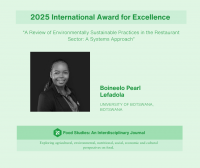
A Review of Environmentally Sustainable Practices in the Restaurant Sector: A Systems Approach
There is increased attention on sustainable practices in the restaurant industry given the adverse impact of restaurants on the environment. This study, therefore, analyzed the body of literature on environmentally sustainable practices in the restaurant sector to identify the common practices implemented at every stage of restaurants, from procurement to waste management and disposal. A scoping review following the guidelines of PRISMA Extension for Scoping Reviews was applied to collect data and thematically analyze the themes emerging from the selected literature. ATLAS.ti version 21 was used to analyze the data. A total of twenty-eight articles documenting environmentally sustainable practices in the restaurant sector were analyzed. From this literature, a total of eighty-three green practices were identified including: thirty-three green inputs, nineteen sustainable practices at the procurement stage, eight green production practices, eight green service practices, and fifteen green safety, sanitation, and maintenance practices. Waste management and disposal strategies were also identified and classified into the waste hierarchy model. From the literature synthesis, a conceptual framework for green practices in restaurants based on the systems theory was developed.
The article, “A Review of Environmentally Sustainable Practices in the Restaurant Sector: A Systems Approach,” contributes significantly to the growing body of scholarship on sustainable food systems and hospitality sustainability by reframing environmental sustainability in restaurants as a systemic rather than isolated challenge. Its primary impact lies in synthesising diverse sustainability practices into an integrated analytical framework that demonstrates the interconnectedness of the food service system's inputs, the transformation of inputs into outputs, controls, waste management, energy consumption, water use, supply chain dynamics, consumer attitudes, and operational decision-making within the restaurant sector. The paper advances the field by highlighting the limitations of fragmented sustainability interventions and emphasising the importance of systems thinking for addressing environmental challenges in the food service industry. In doing so, it provides scholars, policymakers, and industry practitioners with a more holistic understanding of how sustainability transitions can occur within restaurants and broader food systems. The review identifies critical research gaps, emerging trends, and opportunities for integrated interventions that support circular economy principles, resource efficiency, and sustainable consumption.
Importantly, the article strengthens interdisciplinary dialogue between hospitality management, food systems research, and environmental sustainability. By positioning restaurants as influential actors within global food systems, the paper broadens the conversation beyond operational efficiency to include broader questions of environmental responsibility, climate resilience, food waste reduction, and sustainable livelihoods. The systems perspective presented in the article has the potential to guide future empirical research, inform sustainability policies within the hospitality sector, and support the development of more environmentally responsible business models. The paper also contributes methodological value by demonstrating how systems approaches can be applied within restaurant sustainability research. This is particularly important in a field where sustainability practices are often studied in isolation. The article therefore serves as a conceptual foundation for future transdisciplinary studies examining the relationships between environmental performance, restaurant practices, institutional structures, and sustainability outcomes in food service systems.
Within my broader intellectual trajectory, the paper reflects and strengthens my commitment to interdisciplinary, solutions-oriented research on the transformation of sustainable food systems. It aligns with my ongoing work on food waste valorisation, circular economy approaches, and sustainability transitions in food and hospitality systems. The article reinforces the importance of integrating environmental sustainability with social, economic, and institutional dimensions of food systems, while contributing knowledge that is both academically relevant and practically applicable in addressing contemporary sustainability challenges.
—Dr. Boineelo Pearl Lefadola