Call for Papers
Call for Papers
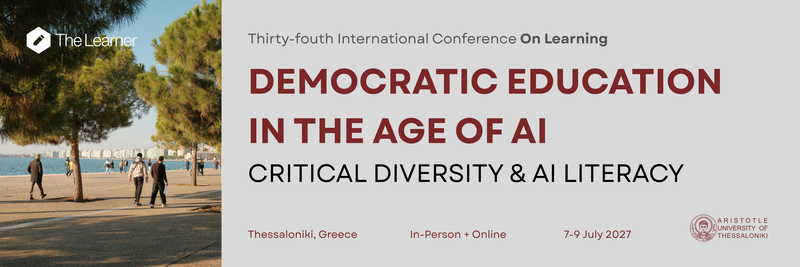
We invite you to join us for the Thirty-Fourth International Conference on Learning, the annual meeting of The Learner Research Network, taking place 7–9 July 2027 in Thessaloniki, Greece, and online, hosted by Aristotle University of Thessaloniki.
The conference brings together educators, researchers, policy makers, and practitioners concerned with learning across formal and informal settings, and with the social, cultural, technological, and institutional conditions that shape educational opportunity.
Special Focus and Themes
The special focus of the 2027 conference, “Democratic Education in the Age of AI: Critical Diversity & AI Literacy,” examines how democratic aims in education—equity, participation, voice, inclusion, and shared public reasoning—are being reshaped by the rapid uptake of artificial intelligence in schools, universities, workplaces, and everyday life. As AI systems increasingly mediate information, assessment, decision-making, and access to opportunity, questions arise about who benefits, who is excluded, how bias is reproduced or challenged, and what it means to learn, teach, and participate responsibly in AI-saturated environments. This focus invites contributions that bring critical diversity perspectives together with AI literacy—not only technical or functional competence, but also ethical, civic, and epistemic capacities: how learners evaluate AI outputs, understand data and model limitations, recognize discriminatory effects, and act as informed participants in democratic institutions.
Hosted in Thessaloniki, a city shaped by layered histories, plural identities, and ongoing debates about belonging, language, and citizenship, the conference offers a fitting setting for examining how education can strengthen democratic life amid technological transformation. We welcome proposals that engage the special focus through research, policy analysis, pedagogical design, classroom practice, professional learning, and community-based work.
Sub-themes:
- Democratic learning futures: participation, civic education, public reasoning, and institutional trust in AI-mediated contexts.
- Critical diversity and inclusion: bias, fairness, accessibility, disability, language, migration, and culturally sustaining pedagogy.
- AI literacy in practice: curriculum, assessment, academic integrity, critical media/data literacy, and teacher education.
- Governance and ethics in education: policy, regulation, procurement, transparency, accountability, and learner rights.
Alongside the special focus, we welcome proposals aligned with the Network’s broader concerns across learning theory and pedagogy; curriculum and assessment; educational leadership and systems; technology-enhanced learning; learning in workplace and community contexts; and the cultural, political, and ethical dimensions of education. Contributions may be theoretical, empirical, methodological, design-based, practice-led, or community-engaged.
Knowledge Experience and Format
The conference is organised as a hybrid knowledge experience, integrating in-person and online participation within a unified scholarly environment. All accepted proposals become Presentation Pages where presenters share abstracts and supporting media, and where delegates engage in discussion before, during, and after the event.
In-person sessions at Aristotle University of Thessaloniki are interwoven with live online sessions and asynchronous contributions within a single integrated program. Regardless of participation mode, all delegates have access to the full schedule, session media, and a growing digital archive. Across formats, the emphasis is on reciprocal, human-scale exchange—conversation, reflection, and collaborative inquiry rather than one-way presentation.
Publication Pathways
Presenters are invited to further develop their conference work for possible publication in the Network’s journals—The International Journal of Learner Diversity and Identities; The International Journal of Adult, Community, and Professional Learning; The International Journal of Assessment and Evaluation; The International Journal of Early Childhood Learning; The International Journal of Educational Organization and Leadership; The International Journal of Learning in Higher Education; The International Journal of Literacies; The International Journal of Pedagogy and Curriculum; and The International Journal of Science, Mathematics, and Technology Learning—or in The Learner Book Imprint, which publishes monographs and edited collections that extend the field of educational research. Both journals and books offer traditional and Open Access publication pathways.
Join Us
We warmly invite you to submit a proposal and to join us—either in Thessaloniki or online—for the Thirty-Fourth International Conference on Learning. Together, we will examine how democratic education can be strengthened in the age of AI, and how critical diversity perspectives and AI literacy can support more equitable, participatory, and accountable learning futures.
Sincerely,
Dimitris Zachos, Local Conference Chair, Professor, Aristotle University of Thessalonki, Thessaloniki, Greece
William (Bill) Cope, Research Network Chair, University of Illinois, Urbana-Champaign, IL, United States
Mary Kalantzis, Research Network Chair, University of Illinois, Urbana-Champaign, IL, United States
José Luis Ortega Martín, Research Network Chair (ES), University of Granada, Granada, Spain