Award Winners for Volume 19
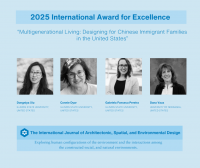
Multigenerational Living: Designing for Chinese Immigrant Families in the United States
Aging has become a social issue, both globally and in the United States. Adapting home environments to accommodate multigenerational living arrangements can engage people aging in place and address the common issues of social isolation and loneliness among aging-in-place adults. This qualitative study explores the interior design needs and concerns of Chinese immigrant families to assess possible adjustments that could promote age-friendly living environments for multigenerational households. Conducted in the midwestern US, the study consists of open-ended interviews conducted with eight participants from four Chinese families living in multigenerational households as well as spatial observations of their interior living arrangements. The researchers identified concerns and needs that were then collated into four themes: merged space, lighting, independence, and safety. Three patterns of adjustment—size, layout, and functionality—emerged as recommendations for comfortably accommodating all generations. Findings demonstrate that multigenerational participants value the specific interior qualities of cleanliness, views, and lighting, as well as comfortable furniture that augments socialization and well-being. Results from this study provide considerations for adapting interior space to improve the living environment of multigenerational households for the benefit of family members of different generations.
This article, “Multigenerational Living: Designing for Chinese Immigrant Families in the United States,” contributes to the field of interior design by addressing a critical gap between evolving household structures, global aging trends, and conventional residential design models. As aging populations increasingly seek to remain in their homes, multigenerational living emerges as a vital strategy to support aging in place while mitigating social isolation and loneliness. This study reframes the home as a dynamic, multifunctional environment that must simultaneously support intergenerational connection, privacy, and individual identity. Drawing on qualitative insights from Chinese immigrant families in the Midwestern United States, the research identifies four key spatial themes—merged space, independence, lighting, and safety—and translates them into actionable design strategies centered on size, layout, and functionality.
A central contribution of this work is its conceptualization of the home as a hybrid of first, second, and third places, where living, working, and socializing coexist to support both social engagement and emotional well-being. This perspective challenges traditional interior design approaches that prioritize static room functions, instead advocating for flexible, adaptive environments that respond to the shifting needs of multiple generations. The study further highlights the importance of specific environmental qualities—such as cleanliness, access to views, adequate lighting, and comfortable furniture—in fostering place attachment, promoting social interaction, and enhancing the physical and mental well-being of residents across age groups. By linking these qualities to age-friendly design and intergenerational living, the article advances evidence-based strategies that are both inclusive and responsive to demographic change.
Equally important, this research brings attention to the cultural dimensions of multigenerational living. By centering Chinese immigrant families, it demonstrates how values such as family cohesion, caregiving, and shared responsibility shape spatial expectations and lived experiences. This calls for a more culturally responsive approach within interior design practice and education—one that moves beyond standardized models to embrace diversity in how people live, age, and connect within the home.
On a personal intellectual trajectory, this project represents a meaningful step in my ongoing exploration of the intersection between design, culture, and social well-being. It reflects my commitment to integrating theoretical frameworks with real-world applications and to amplifying underrepresented perspectives in design research. This work informs both my scholarship and teaching, encouraging future designers to approach residential environments with empathy, adaptability, and cultural awareness
—Dongniya Xiu, Connie Dyar, Gabriela Fonseca Pereira, and Dana Vaux