Call for Papers
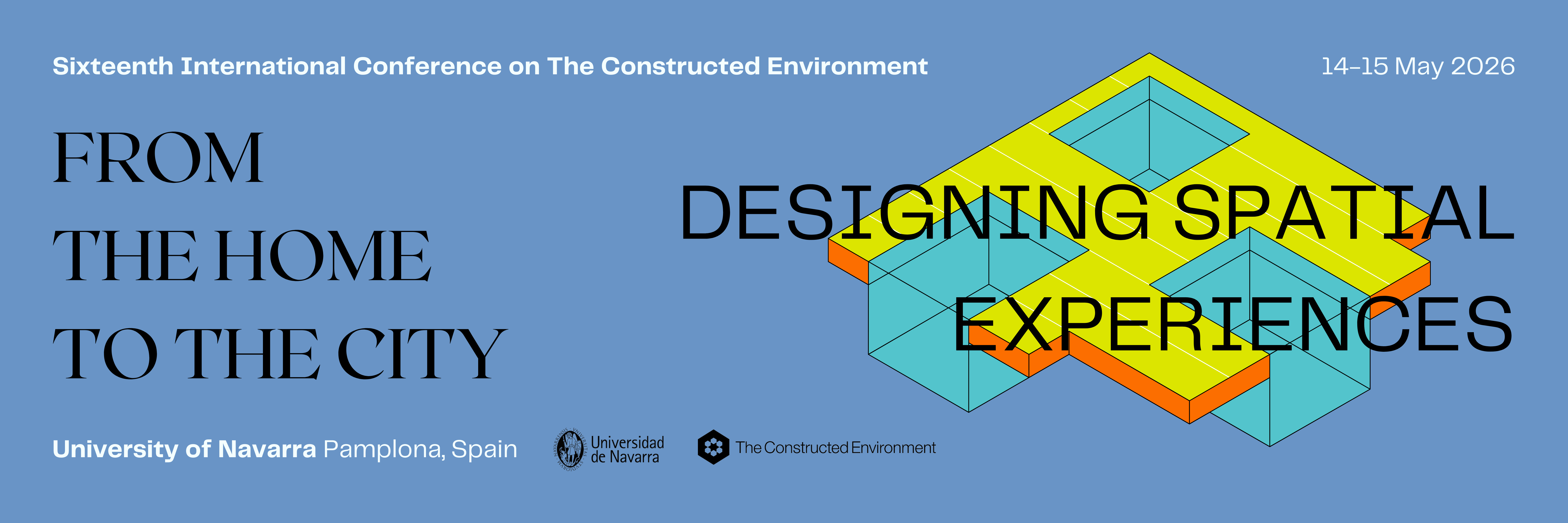
We invite you to join us for the Sixteenth International Conference on the Constructed Environment, the annual meeting of the Constructed Environment Research Network, taking place 9–10 May 2026 in Pamplona, Spain and online, in partnership with our host institution, Universidad de Navarra. The Network brings together architects, designers, planners, engineers, environmental psychologists, artists, sociologists, and scholars whose work engages the complex relationships between built environments, social worlds, and natural systems. We welcome proposals examining how space is formed, inhabited, represented, contested, and transformed across scales—from interior atmospheres to urban systems and regional ecologies.
In 2026, our special focus “From the Home to the City: Designing Spatial Experiences” invites participants to explore how thoughtfully designed environments—from intimate domestic interiors to expansive urban landscapes—can foster human wellbeing, social connection, and environmental responsibility. At the domestic scale, the focus examines how homes shape daily routines, emotional health, and social interactions, highlighting design’s role in creating spaces of care, comfort, and dignity. In the context of remote work, aging populations, and global housing crises, we welcome research that addresses both technical dimensions—such as sustainability, adaptability, and healthy materials—and sensory and affective aspects, including spatial form, natural light, and tactile qualities. Echoing architect Kazuo Shinohara, we consider how domestic space remains a vital site of cultural expression and personal identity.
At the urban scale, the focus investigates how cities can cultivate inclusive, resilient, and engaging environments amidst rapid urbanization, climate change, and social inequality. We encourage contributions that explore participatory planning, interdisciplinary collaboration, and empathetic design practices that foster safety, accessibility, and belonging. As Jan Gehl observed, thriving cities are places of joyful human interaction—spaces designed for lingering, sharing, and meaningful connection.
We also invite work addressing the “in-between”: shared community spaces, transitional interiors, collective housing, and neighborhood infrastructures that mediate between private and public realms. These are thresholds of care and encounter, demanding design responses attentive to overlapping cultural, social, environmental, and material needs.
This year’s themes include: The Design of Space and Place; Constructing the Environment; Environmental Impacts; and Social Impacts. We welcome multidisciplinary contributions that engage these themes critically and creatively, advancing the discourse on designing resilient, empathetic, and sustainable spaces for contemporary life.
Knowledge Experience and Format
The conference is organised as a hybrid knowledge experience, bringing in-person and online participation together in one integrated scholarly environment. All accepted proposals become Presentation Pages on CGScholar Event (KX), where presenters can share abstracts, media, and reflections and where delegates can continue conversation before, during, and after the event.
In-person presentations, live online sessions, and asynchronous contributions are woven into a single shared program. Regardless of participation mode, all delegates have access to the full schedule, session media, and a growing digital archive. Across formats, the emphasis remains on collegial, human-scale exchange—conversation, reflection, and collaborative inquiry—rather than one-way presentation.
Publication Pathways
Presenters are invited to develop their work for possible publication in The International Journal of Architectonic, Spatial, and Environmental Design, which examines human configurations of the environment and the interactions between constructed, social, and natural systems, or in the Constructed Environment Book Imprint, which publishes monographs and edited collections advancing research on spatial design, material culture, urbanism, and environmental futures. Both outlets offer options for traditional and Open Access publication.
Membership and Community
We welcome new and returning members to the Constructed Environment Research Network. By purchasing a Presenter Pass, you automatically become—or renew as—a Network Member for the year, with benefits that span both our online environment and our in-person programs. Membership places you inside our online Knowledge Experience in practice. Built by and for members, this shared space connects the full cycle of our work—and your work: preparation, presentation, reflection, and publication. Scholar-led and inclusive by design, it functions as a living commons for reciprocity, rigor, and continuity. Online, you can access everything in one place—conference updates and media, calls for papers, programs, archives, and journal and book content—and use it to share your ideas and current activities. All member posts undergo peer-facilitated community review before being added, a social process of creation, review, and sharing that strengthens collective knowledge and community.
Alongside this online member experience, membership also supports and is activated through our in-person conferences and events, where you can meet peers, participate in sessions, and build new collaborations with our host partners. Membership sustains the Research Network, ensuring continued access to programs, archives, journals, and books and keeping ideas in motion over time—where belonging is defined by contribution and care.
Join Us
We warmly invite you to submit a proposal and to join us—either in Pamplona or online—for this year’s annual meeting of the Constructed Environment Research Network. Together, we will explore how spatial design—from the home to the city—shapes human experience, community life, and environmental futures.
The 2026 convening is led by Fabian Neuhaus (Research Network Chair), Dr. Javier Antón Sancho and Dr. Víctor Larripa Artieda (Local Conference Committee), and the broader community of scholars and practitioners who sustain the Constructed Environment Research Network.
Sincerely,
Dr. Javier Antón Sancho, Conference Committee, Universidad de Navarra, Spain
Dr. Víctor Larripa Artieda, Conference Committee, Universidad de Navarra, Spain
Dr. Maria Villanueva Fernandez, Conference Committee, Universidad de Navarra, Spain
Dr. Alvaro Velasco Perez, Conference Committee, Universidad de Navarra, Spain
Dr. Asier Santas Torres, Conference Committee, Universidad de Navarra, Spain
Dr. Juan Roquette Rodriguez-Villamil, Conference Committee, Universidad de Navarra, Spain
Dr. Aitor Acilu Fernandez, Conference Committee, Universidad de Navarra, Spain
Dr. Fabian Neuhaus, Research Network Chair, University of Calgary, Canada
Dr. Phillip Kalantzis-Cope, Chief Social Scientist, Common Ground Research Networks, United States of America